Material & loading
Material composition, particle size or part dimensions, loading container and batch size.
RBSJ / Batch processing
A mechanically operated lift furnace for batch heat treatment. Loading space and heating elements are selected around the load and the firing schedule.
Discuss your processAtmosphere elevator furnace
01 / 03Engineering
The lift structure gives free access to the loading platform for charging and discharging. Chamber and platform dimensions follow the load defined by the project.
The original documentation covers a polycrystalline mullite fibre chamber, over-temperature protection and earth-leakage protection. Heating elements are selected against the final working temperature.
It fits when: batches are small and the product mix is varied; a single part is too large or too heavy to handle, so a crane or forklift places it on the hearth and the furnace body lowers over it; the work is trials, pilot runs or comparison of several formulations; the temperature requirement is high — this model reaches 1800 °C, among the highest in the range.
It does not fit for: continuous high-volume production — loading and unloading is the bottleneck in any batch furnace; a line where an in-furnace conveyor has to link upstream and downstream equipment.
The one-line test: work that will not fit, and does not justify a continuous line, belongs on an elevator furnace.
Q: What is the difference between an elevator furnace and a bogie hearth furnace? In an elevator furnace the body moves and the load stays still. In a bogie hearth furnace the load travels in and out on a car. The first suits heavy parts handled by crane; the second suits larger batches that need rail access.
Q: How long do MoSi₂ elements last? We do not quote a number. Service life depends on working temperature, atmosphere cleanliness, heating and cooling rate, and maintenance of the protective layer on the element surface — the same rod behaves very differently in different duty. What can be said is that frequent cycling at low temperature, and atmospheres carrying moisture or sulphur, shorten life noticeably.
Q: At what temperature can parts be unloaded? It follows from the cooling requirement in the process. Fast cooling needs a cooling arrangement, and that changes the furnace design.
RBSJ
Swipe horizontally to view all configurations.
| Parameter | 15 kW | 20 kW | 30 kW |
|---|---|---|---|
| Power configuration | 15 kW | 20 kW | 30 kW |
| Supply | 380 V | 380 V | 380 V |
| Control accuracy | ±1 °C | ±1 °C | ±1 °C |
| Lift travel | 320 mm | 350 mm | 400 mm |
| Overall dimensions (mm) | 1510 × 1850 × 2000 | 1620 × 2100 × 2400 | 1870 × 2340 × 2890 |
| Reference weight | 1120 kg | 1800 kg | 2320 kg |
The data below describe reference configurations. Final specifications, including power supply and performance requirements, are agreed for your project.
The catalog lists custom temperature options from 600 to 1800 °C across configurations. The suitable maximum, loading space and heating rate must be specified together. Photos show example installations, not necessarily the tabulated configurations.
Discuss your processZKR / Engineering
Share the information below with our international sales team. Our engineers will use it to assess a suitable furnace configuration.
Material composition, particle size or part dimensions, loading container and batch size.
Peak and operating temperatures, heating rate, hold time and cooling requirements.
Process gas, gas quality, exhaust requirements and available electrical supply.
Target throughput, operating schedule, floor space and upstream/downstream equipment.
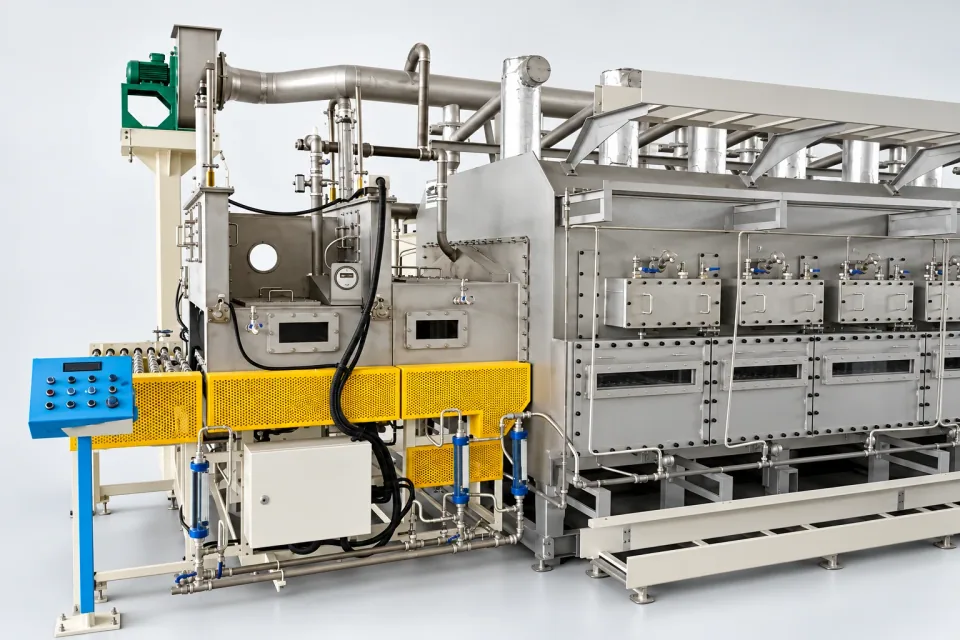
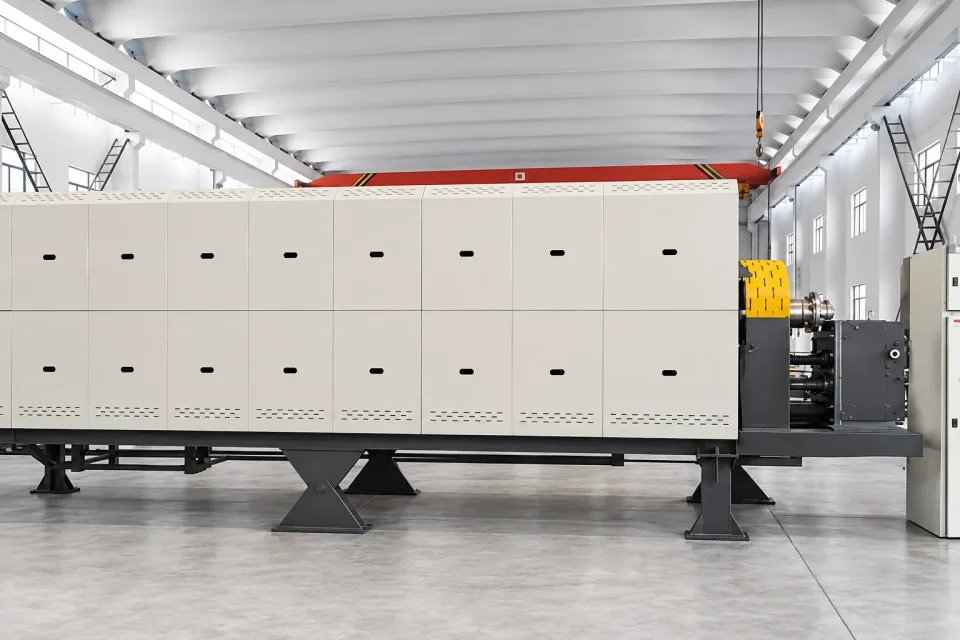
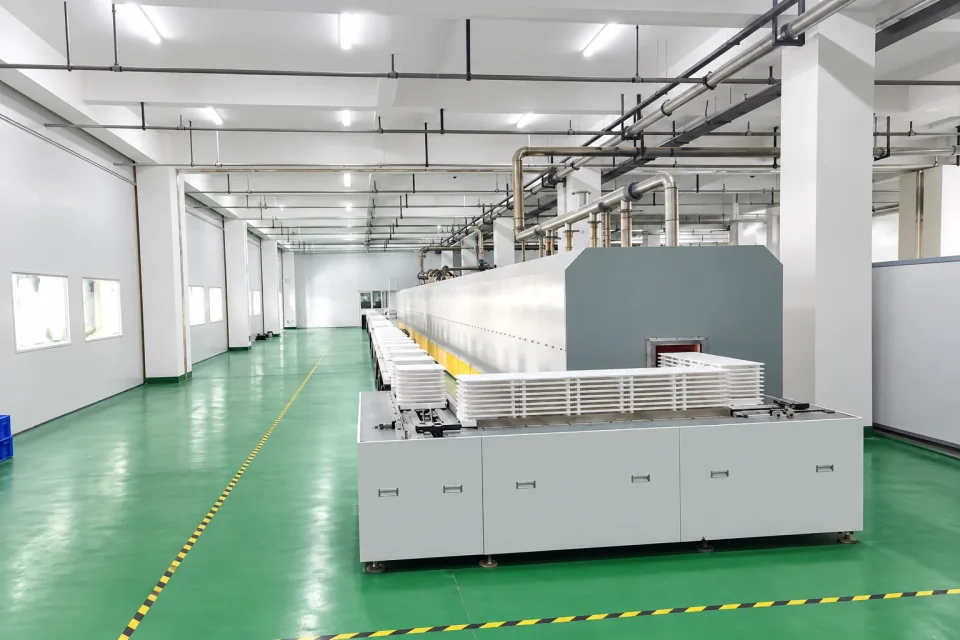
Images show supplied equipment configurations. The presentation image is retouched from the original; other images are original workshop records. Final equipment is defined by the agreed technical proposal.
Contact us
Share your material, temperature profile, atmosphere and target output. Our international sales team will coordinate the technical review with our engineers in Yixing.
Atmosphere elevator furnace
* Required fields