Material & loading
Material composition, particle size or part dimensions, loading container and batch size.
ZYTK / Continuous tray transport
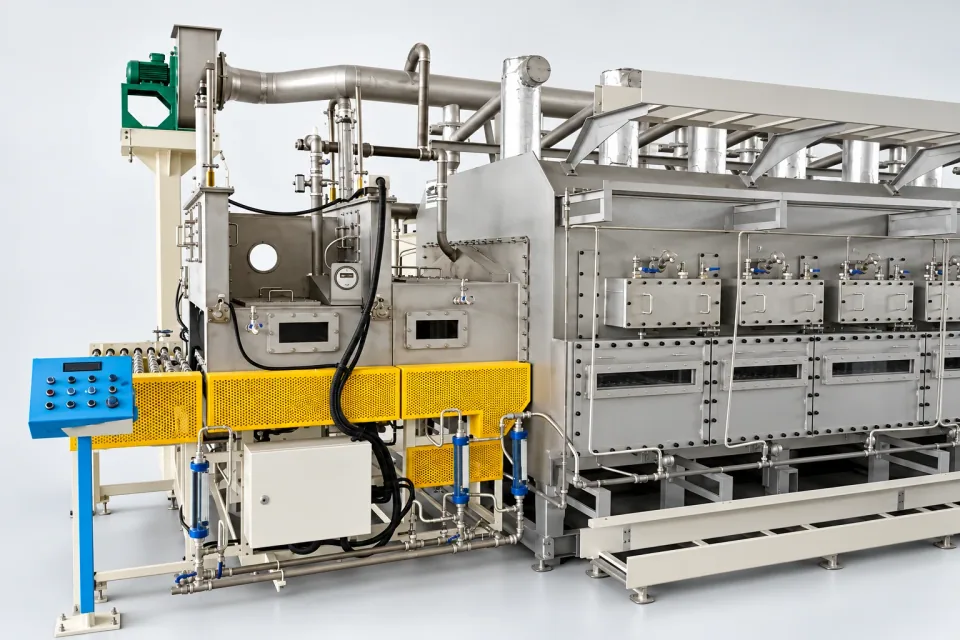
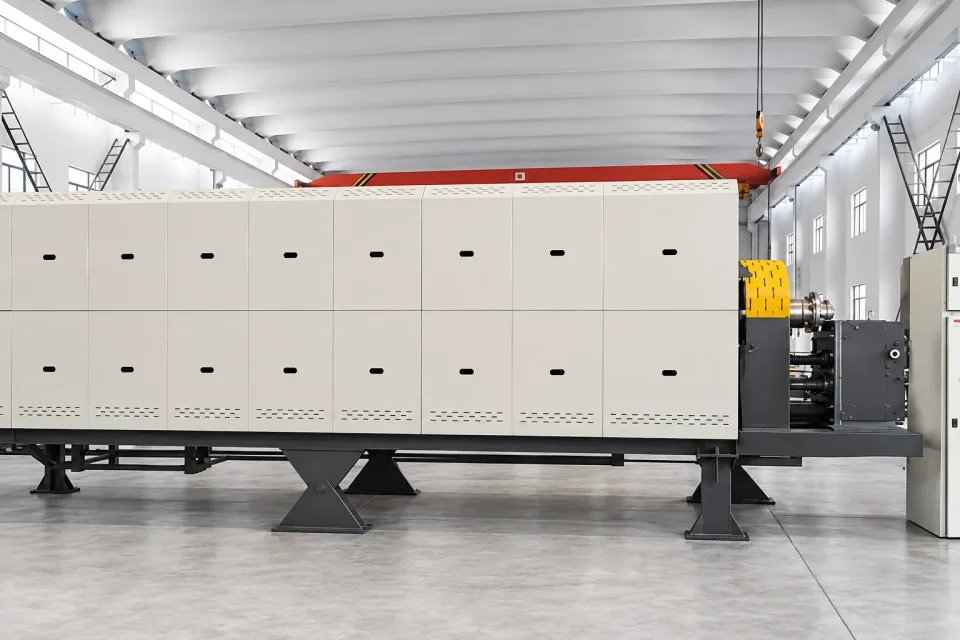
A continuous furnace that advances supported loads through successive temperature zones. Designed around the setter, material and required firing profile.
Discuss your processAtmosphere pusher furnace
01 / 03Engineering
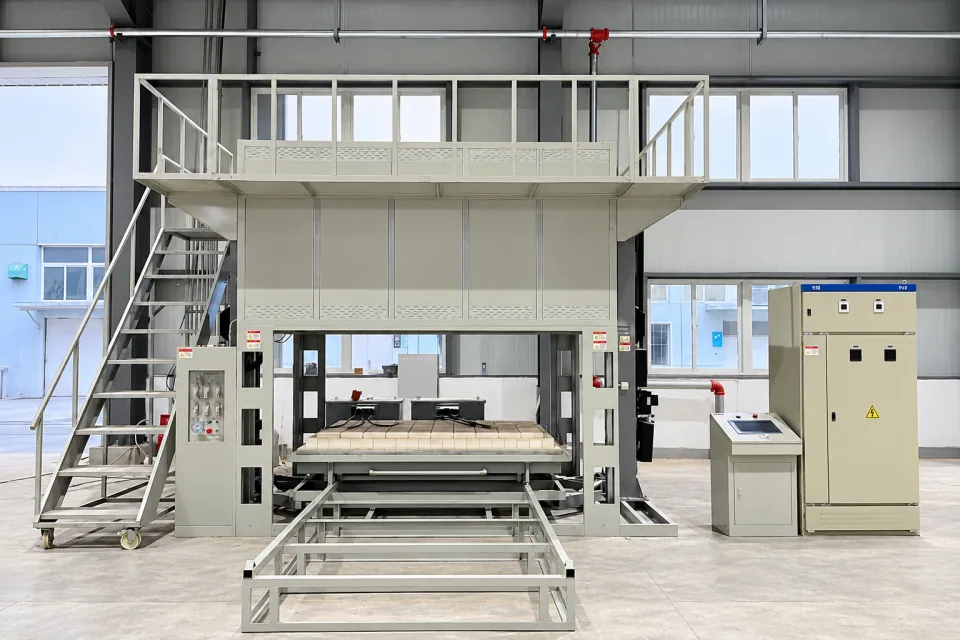
A pusher plate drives the carrier, or the loaded saggar, through preheat, firing and cooling in sequence. The loading method and the push interval follow from the residence time the process requires.
The original design uses a corundum-mullite high-temperature chamber with alumina bubble insulation. Heating arrangement and exhaust method are matched to the specific process.
It fits when: the plant runs continuously and the load sits in a saggar, pushed forward plate by plate at a fixed interval; output demand is high and the product mix is stable; the process temperature is high — this model reaches 1800 °C, the top of the range alongside the elevator furnace; the process needs vacuum or a controlled atmosphere and still has to run continuously.
It does not fit when: the product mix changes often — interval, pusher plate size and saggar format are one linked set of parameters; the load is thin, tall or unstable — the inertia of each push knocks it over; the building cannot accommodate the return section for the in- and outfeed.
The one-line test: a pusher furnace trades rhythm for output. Once the rhythm breaks, the whole line breaks.
Q: Pusher furnace or roller hearth — how do we choose? Temperature, load, and whether vacuum is needed. The roller hearth tops out at 1500 °C, does not offer vacuum and suits flat parts in continuous flow. The pusher furnace reaches 1800 °C, can be built for vacuum, and suits saggar-based continuous production. When both can run the same load, compare output and saggar format.
Q: Will the plates jam? Jamming usually comes from three causes: a deformed pusher plate, debris on the track, or an interval that does not match the temperature profile and causes local over-firing and sticking. The design provides access ports; operation requires track cleaning to procedure.
Q: How much can one line produce? It depends on saggar load, interval per plate and the number of positions in the furnace. Only after those three are fixed can daily output be calculated. Any "tonnes per day" figure without a saggar specification is meaningless.
ZYTK
Swipe horizontally to view all configurations.
| Parameter | ZYTK-70-13 | ZYTK-120-13 | ZYTK-200-13 | ZYTK-260-13 |
|---|---|---|---|---|
| Heating power | 70 kW | 120 kW | 200 kW | 260 kW |
| Supply | 380 V / 3~ | 380 V / 3~ | 380 V / 3~ | 380 V / 3~ |
| Heating zones | 9 | 12 | 15 | 18 |
| Control points | 11 | 16 | 20 | 26 |
| Chamber dimensions (mm) | 12000 × 380 × 220 | 16000 × 380 × 220 | 20000 × 760 × 270 | 25000 × 760 × 270 |
| Plate dimensions (mm) | 340 × 340 × 30 | 340 × 340 × 30 | 340 × 340 × 30 | 340 × 340 × 30 |
| Instrument accuracy | ≤ ±1 °C | ≤ ±1 °C | ≤ ±1 °C | ≤ ±1 °C |
The data below describe reference configurations. Final specifications, including power supply and performance requirements, are agreed for your project.
The source catalog gives a process-dependent working range up to 1700 °C. Heating elements, refractory lining and atmosphere must be specified for the selected temperature. Instrument accuracy is not the same as load temperature uniformity.
Discuss your processZKR / Engineering
Share the information below with our international sales team. Our engineers will use it to assess a suitable furnace configuration.
Material composition, particle size or part dimensions, loading container and batch size.
Peak and operating temperatures, heating rate, hold time and cooling requirements.
Process gas, gas quality, exhaust requirements and available electrical supply.
Target throughput, operating schedule, floor space and upstream/downstream equipment.
Images show supplied equipment configurations. The presentation image is retouched from the original; other images are original workshop records. Final equipment is defined by the agreed technical proposal.
Contact us
Share your material, temperature profile, atmosphere and target output. Our international sales team will coordinate the technical review with our engineers in Yixing.
Atmosphere pusher furnace
* Required fields