Material & loading
Material composition, particle size or part dimensions, loading container and batch size.
ZYWK / Continuous belt processing
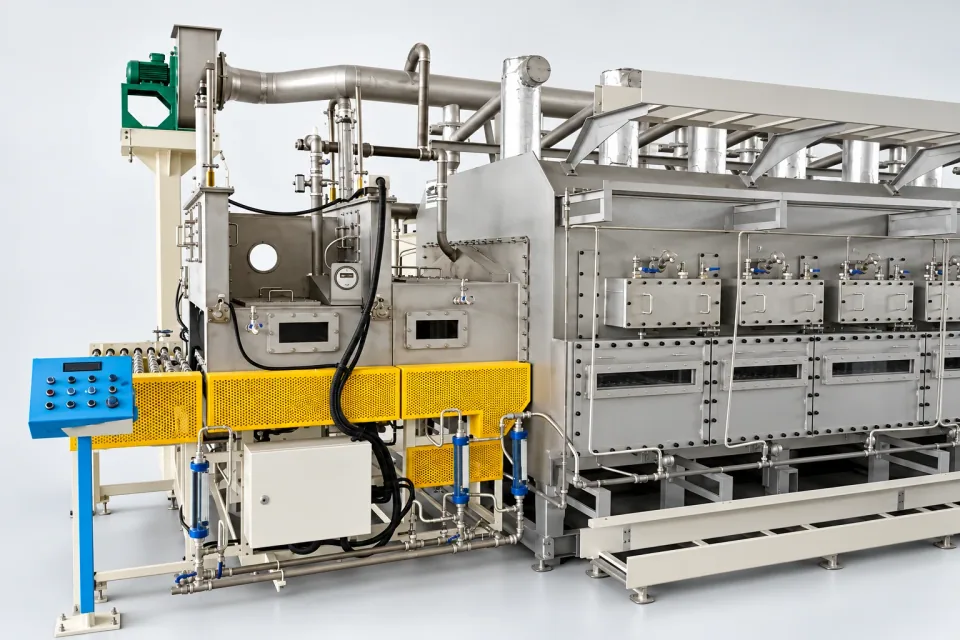
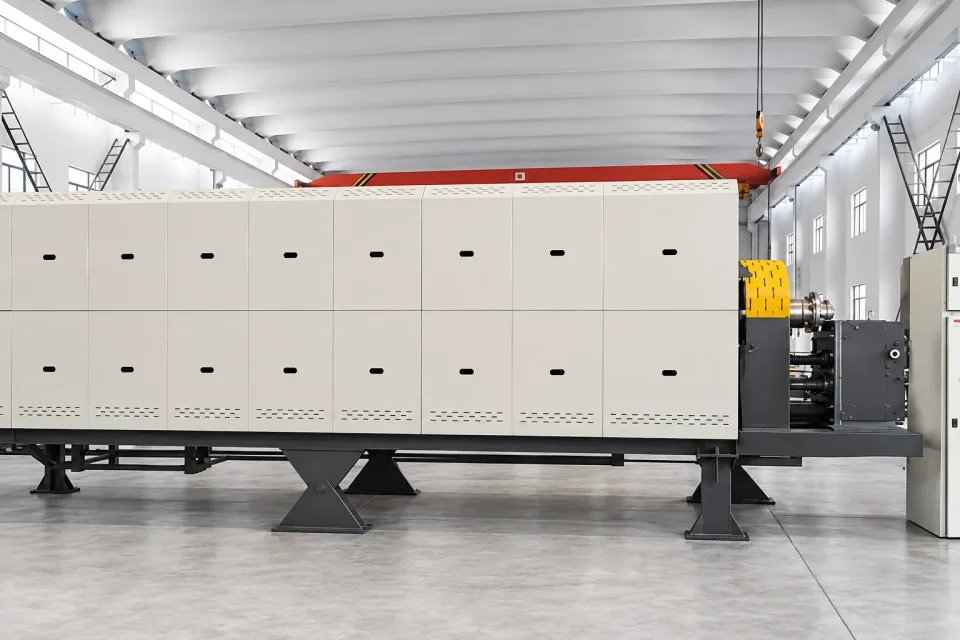
A continuous mesh-belt line for component heat treatment. Transport speed, heating zones and cooling are configured for the component and its thermal cycle.
Discuss your processAtmosphere mesh-belt furnace
01 / 04Engineering
The original documentation describes a line built from infeed, pre-firing, sintering, controlled cooling and outfeed, with the mesh belt conveyor and a PID temperature control system.
The product family covers powder-metallurgy sintering, thick-film firing and atmosphere joining as separate configurations. One temperature class does not fit every process.
It fits when: the parts are small, thin or loose and can lie flat on the belt; the process temperature stays at or below 1100 °C; the plant needs continuous, stable, automatic loading and unloading; each zone should be controlled independently.
It does not fit when: process temperature exceeds 1100 °C — this is not a heating limitation but the strength limit of the belt material itself, and exceeding it writes the belt off early; individual parts are heavy or loads are concentrated — the belt is the load-bearing element and a point load will collapse it locally; the process calls for long holds at high temperature under heavy load.
The one-line test: the cost of a mesh belt furnace is not in the furnace, it is in the belt. Ask first how long the belt will survive at that temperature.
Q: Why is the limit only 1100 °C? The limit comes from the belt, not the heating elements. The elements listed for this model could support higher temperatures, but the load carrier cannot. Higher temperature means changing the carrier principle — rollers or pusher plates.
Q: How often does the belt have to be replaced? Judge on operating hours, temperature, atmosphere and load together; there is no single answer. What is certain is that over-temperature operation, rapid heating and cooling, and local overload are the three main causes of short life.
Q: Will thin parts drift or overlap on the belt? Yes. That is why the loading method and the belt tensioning arrangement have to be designed together — in practice this affects yield more than the furnace body does.
ZYWK
Swipe horizontally to view all configurations.
| Parameter | 12 kW | 24 kW | 45 kW | 60 kW | 75 kW | 90 kW | 105 kW | 120 kW |
|---|---|---|---|---|---|---|---|---|
| Heating power | 12 kW | 24 kW | 45 kW | 60 kW | 75 kW | 90 kW | 105 kW | 120 kW |
| Rated temperature | 920 °C | 920 °C | 920 °C | 920 °C | 920 °C | 920 °C | 920 °C | 920 °C |
| Supply | 380 V / 3~ | 380 V / 3~ | 380 V / 3~ | 380 V / 3~ | 380 V / 3~ | 380 V / 3~ | 380 V / 3~ | 380 V / 3~ |
| Reference working space (mm) | 700 × 90 × 30 | 1300 × 150 × 50 | 2300 × 220 × 50 | 2400 × 300 × 50 | 3700 × 300 × 50 | 4700 × 300 × 50 | 4200 × 400 × 80 | 4700 × 400 × 80 |
The data below describe reference configurations. Final specifications, including power supply and performance requirements, are agreed for your project.
These values describe the published ZYWK catalog configurations. Other materials and firing or joining processes require a separate temperature, atmosphere and belt specification.
Discuss your processZKR / Engineering
Share the information below with our international sales team. Our engineers will use it to assess a suitable furnace configuration.
Material composition, particle size or part dimensions, loading container and batch size.
Peak and operating temperatures, heating rate, hold time and cooling requirements.
Process gas, gas quality, exhaust requirements and available electrical supply.
Target throughput, operating schedule, floor space and upstream/downstream equipment.
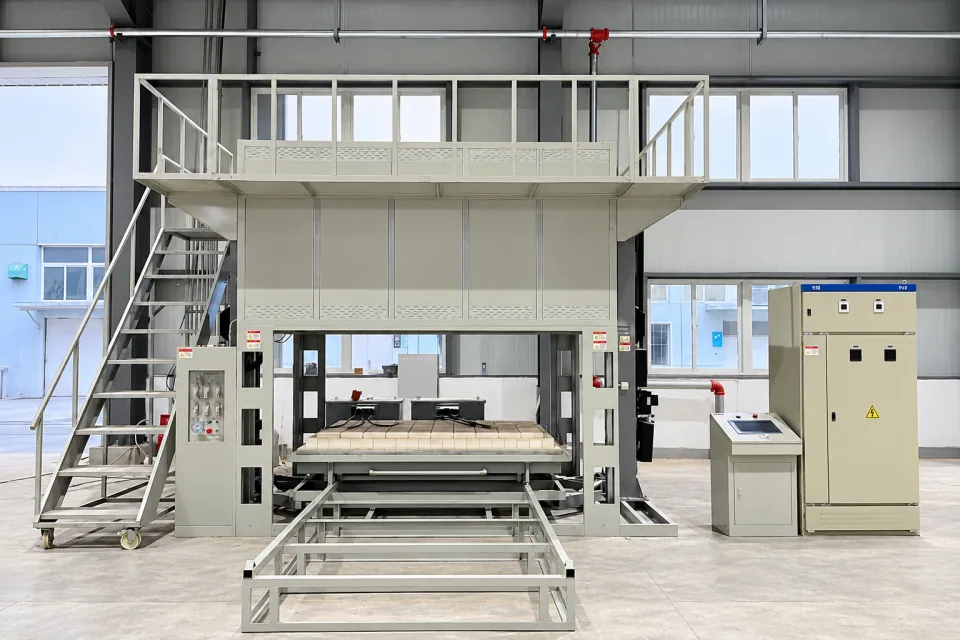
Images show supplied equipment configurations. The presentation image is retouched from the original; other images are original workshop records. Final equipment is defined by the agreed technical proposal.
Contact us
Share your material, temperature profile, atmosphere and target output. Our international sales team will coordinate the technical review with our engineers in Yixing.
Atmosphere mesh-belt furnace
* Required fields